Friday, March 27, 2015

MYST Post #2: The Master


 After watching There Will Be Blood (2007), I was eager to watch anything else Paul Thomas Anderson had directed. So when I was looking at his filmography, the first movie that caught my eye was The Master(2012), because of the story and the actors. Its of a man played by Joaquin Phoenix desperate to gain his sanity and goes to great lengths in his attempts. Also involved is a charismatic cult leader played by Phillip Seymour Hoffman and his loyal wife played by Amy Adams. After watching the movie I was pleased with my experience with the movie, but my Dad really disliked all of it. After reading the online reviews, it seemed to be a polarizing movie, either you loved it or hated it. I found myself more in between because I enjoyed the different parts of the movie such as the acting, the editing, and the story, but together as a whole, something was missing. I think that it was a lack of relatability. Though the story is gripping and deep, I don’t think that at any point of the movie can we find ourselves in the same position as these characters, well at least I hope not.


The movie is at its peak when Joaquin Phoenix’s character, Freddie Quell, joins Philip Seymour Hoffman’s character,, cult. He is hoping that Philip seymour Hoffman’s character Dodd holds the key to unlocking his sanity by his method of “processing” his followers memories. The scene where Freddie is going through the processing methods is one of my favorites in the movie. It starts with Dodd asking Freddie if he’d liked to be processed, after Freddie eagerly agrees, we watch Freddie experience the different techniques that Dodd has developed. The first is being asked questions without blinking, and if you blink the process has been ruined and you have to start again. The next is staring into someones eyes and mentally changing the color. Then lastly, the final method is walking between a window and a wall until the area around you has mentally changed. What makes this scene so great for me is that we see the character slowly go from hopeful and optimistic to frustrated and angry and because the it means so much to him, it is extremely personal. Like Freddie we are also experiencing a bit of a revelation because up until this point in the movie, Dodd seemed very credible and we experience the truth unraveling with our character. The performance by Joaquin Phoenix is amazing and is perfectly displayed in this scene. This is an important scene in regards to plot as well because in the scene Freddie goes from loyal follower, to a non believer and a huge risk for the whole cult. It is this scene that really sold me on the movie.


Through the movie we see that Paul Thomas Anderson has developed a style that
has helped push his movies into critical acclaim. The techniques used in this movie were a bit different from There Will Be Blood. In this movie while he still uses a lot of moving camerawork he also uses a lot of long takes for the conversations and processing in the movie. The mix of the two was useful in being able to see into Freddie’s state of mind. Also used in this movie is the use of the same style character, a desperate and flawed character whose flaws interfere with his everyday life tremendously. For his movies, its this character who pushes the story forward. I found it interesting that he switched between a 70mm camera and a 35mm camera. The 70mm camera has a higher resolution but is also used less and not compatible with many movie theatres.  You can really see the difference between cameras when he is on Dodd's boat because the ocean looks amazing but the inside looks dark and barren.   Like the use of the different types of shots, this also helped show the contrast between scenes the gritty scenes become grittier and the pretty scenes become prettier. Paul Thomas Anderson utilizes all of this to make his movie much clearer and deeper for the watcher. 
 
 
 If you are a hardcore movie fan then I’d recommend this movie because it has great camera work and a great story, but if you are looking for a movie to be entertained by, then I would not recommend this movie because like my dad you would probably find it boring and like the movie was trying too hard to say something. Also if you are a fan of acting then I would definitely recommend this movie, the performances given are so powerful that the three main characters were nominated for Oscars. If you are a fan of Paul Thomas Anderson I would also suggest this movie. Personally, seeing him progress from Punch Drunk Love to There Will Be Blood to The Master has been a treat to watch. While I still think think that There Will Be Blood is his best movie, I think The Master shows the best direction in it. If you like movies like Her(2013), Crazy Heart(2009), or Birdman(2014) then I think you will enjoy this movie. I’d rate this movie a solid 3 out of five Devitos


Sunday, March 15, 2015

Formal Film Study: The Dollars Trilogy

I remember buying my dad the Dollars Trilogy when I was much younger for his birthday, and at the time, it did not really interest me because Western movies were just a weird genre that my dad would watch.  As I got older though,  I began to enjoy the genre more and more with movies like True Grit and My Name is Nobody.  So when I was given this assignment, the first thought I had was to go back to where the Spaghetti Western started.  The Spaghetti Western start with the three Sergio Leone films,  A Fistful of Dollars(1964),  A Few Dollars More(1965), and The Good, The Bad, and The Ugly(1966).  Their influence can be seen through the rest of the Western genre and it is from this that I came to the conclusion that the modern western was born from these three movies. 

The trilogy was shot with a distinct style in mind from the beginning.  Sergio Leone wanted to do something new with the Western genre because he felt that they began to fall short of what a
Western should be.  He has stated that he felt that, "the American westerns of the mid to late fifties had become stagnant, overly-preachy and not believable"(Leone).  With this in mind we can begin to look at the techniques and styles he used to make a different more believable Western.  With these techniques he reinvented the western genre.  Starting with the characters in the movie, the line between hero and villain is a lot less clear.  Leone uses an anti-hero in all three films where the protagonist is greedy and ruthless just like the villains but also lives and acts by a set of morals that keep the audiences favor with the lead.  For example in The Good, The Bad , and The Ugly we get introduced to the three title characters with their titles next to their still after a character defining action.  For Clint Eastwood who plays The Good, his action is that after he teams up with one of his bounties to collect the money he helps them escape so that they can do the plan again in another town.  After Eastwood cheats his partner and leaves him tied the movie pauses and we are introduced to him as The Good.


This is a drastic change in not only Western movies but the industry as a whole, because even though the noire style anti-hero was now a popular character, they had to yet to go as far as Leone's characters.  Also, the majority of movies were still Frank Capra style family friendly movies with a happy ending and message at the end.  Eastwood confirms this by saying on his end that,"In Rawhide I did get awfully tired of playing the conventional white hat. The hero who kisses old ladies and dogs and was kind to everybody. I decided it was time to be an anti-hero"(Eastwood).  Through the Dollars trilogy the good guys can only be seen as relatively good. 

Leone uses through his directing, techniques that at the time were unthought of.  This is shown within the movies and is used repeatedly for common effect.  For example the use of spacing between characters and buildings were used to give a deeper more paced feel to the movie.  This allowed the director to also use a deep space composition to show more action and depth at once giving the movie a more realistic town feel.  Lastly, now a trademark in the genre, Leone implemented closeup and extreme closeups, not as reaction shots or for dramatic lines which was popular during the time, but for increasing the tension between connected characters. This popularized the Eastwood scowl that was imitated by movies eversince.  Also this allowed the score to become as important as the dialogue and to give its own flavor to the movie.   


Also, common in the Man With No Name trilogy is the story and plot.  In all three movies the main character, Clint Eastwood puts himself in situations where there is a conflict between two  parties and he controls the parties through manipulation to push the movie forward and to gain as much through the two as possible.  He is then caught by one of the two parties and is beaten but not broken, he then escapes his captors and returns for the climax fight scene.  Through the movie there is a lot that pushes the boundaries of American cinema and with the gained popularity of the first movie the second and third take much more risks then the first.  For example in the first movie there is still a lot of killing and shooting but the actors fall certain ways to cover the shots and prevent showing the injuries, but in For a Few Dollars More,  the opening scene shows a man being shot in the head falling back into the camera only to reveal the bleeding bullet hole in his head.  Also, in A Fistful of Dollars, the main character saves a family that is about to separated and killed, but in For a Few Dollars more before the main character enters the city, the villain orders a wife and her 18 month year old baby to be killed off screen.  Lastly, one of the characters in The Good, The Bad, and The Ugly, breaks into a hotel to find a woman bathing.  These important plot points pushed the envelope as far as American cinema code went and made for a more realistic grittier movie. 

This change of direction for such a popular genre had huge effects on culture.  The main influence on culture is the change in protagonist because for decades after these movies,  Clint Eastwood was the image of a tough guy.  He was a man that other men would strive to be.  This is a change of culture compared to the self described white hat protagonist that ruled before the Dollars Trilogy.  This gave a message that a tough guy or a real man takes what he wants, but not from the innocent bystanders, only the bad that were guilty of exploiting their power.  This message was powerful considering the size of audience. 

In conclusion the Man With No Name trilogy had an impactful influence on not only the Western genre or the movie industry, but on society as a whole.  This can seen through the movies that they influenced and the audience that they reached.  Without the Dollars Trilogy perhaps the Western as we know it may have never came to be.


Monday, February 16, 2015

MYST Post #1: Snatch


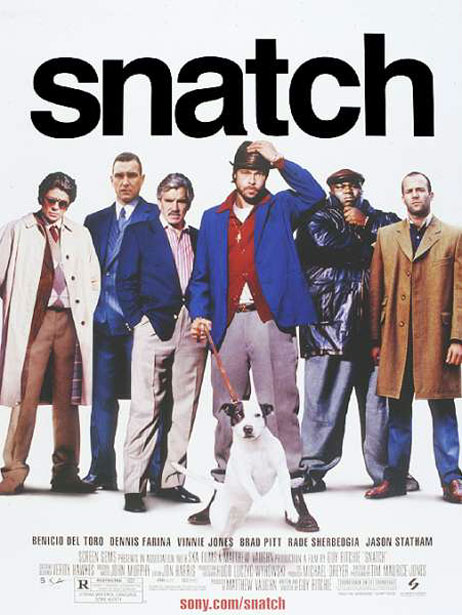
            I remember when I first watched this movie it was at night with my dad and I did not quite know what to expect.  The movie recommendations from my dad are either hit or miss so I did not know if this was going to be two hours well spent or two hours spent looking at the clock.  I am glad to say that Snatch was an awesome movie that I now have to watch every time it’s on.  The story revolves around different groups of seedy men all involved in some sort of underground business, and they all get connected by a priceless giant diamond.  It is a crime thriller with a comic tone to it and includes actors like, Jason Statham, Brad Pitt, and Benicio Del Toro.  It is directed by Guy Ritchie and is considered a follow up to Lock, Stock, and Two Smoking Barrels.  Although similar in style and technique I definitely prefer Snatch, because it used the efforts of the first movie to perfect it. 
           This movie flows and moves quickly; almost every shot that is used is a dolly shot or some other form of moving shot.  When the characters and camera are not moving, the cuts are very quick and very short.  This helps keep the audience on its down by helping the plot seem unsettled and the future story as unpredictable.  Also used in the movie is a very dull color scheme.  The whole movie seems to be shot through a blue steel lens that keeps the movie gritty and not overly comedic.  With these used in combination it gives a unique movie experience because not many movies are done this way.  Guy Ritchie will use this same method again in the Sherlock Holmes movies.

 
            The scene in my opinion that epitomizes the movie is when early on, two of the main characters wish to buy a caravan from the local gypsies and after many odd interactions with them, they are introduced to their leader played by Brad Pitt.  This leads to the failed negotiation on price and the determination that the only way to settle it is in a Bare knuckle boxing match.  The two main characters are confident in this proposition, because after all, they have the Heavyweight underground boxing champion fighting for them.  The fight starts with their boxer, “Gorgeous George”, giving the much smaller Brad Pitt a nasty beating while he seems to be stretching out.  After being warmed up he knocks out George and for a while thinks he killed him, which makes out horribly for the main characters because they may have witnessed murder committed and gypsies do not like to leave witnesses.  The scene works because although it seems almost pointless to the plot, it is weaved perfectly into the movie and used to throw the movie even further into uncertainty.  It continues to show that movie will intertwine action with humor with quirky dialogue and odd characters.  It is at this point in the movie where you begin to understand the process that the movie will use. 
 
            I recommend this movie to anyone who enjoys the stereotypically male genres of Action, Adventure, Thriller, or Comedy. Also if you enjoyed, Pulp Fiction, The Boondock Saints, or Lock Stock and Two smoking barrels then you will enjoy this movie as well.  I will have to give this move a solid 4 out of 5 Danny Devitos


Wednesday, January 28, 2015

Review of the Reviews


Rax Reed, of The Observer, reviewed the movie Birdman and through the review it is clear that he did not only dislike the movie, but he is annoyed by the success it has had so far.  First, he gives the background on the movie and its actors, then he goes on and lazily explains the plot that is seen in the movie.  While he is giving the plot he is picking out the things he disliked about the movie and comes to the conclusion that the movie stupid.  The thesis of his review is that this play is pointless and is overrated, but the process he uses is wrong.  Through the the review you can feel the tone of his explanations is that "I do not relate or even understand the play and therefore it is stupid".  You get this feeling because he writes off key points of the movie that even if you do not understand them, you understand their importance to the film.  For example, when Michael Keaton uses his "powers" at the end of the movie, he explains it as his character giving up and levitating away and makes no connection to the rest of the movie.  I would be alright with reading a negative review, but not one that bashes a movie simply because he does not understand the movie. 

I do not disagree with the review entirely though,  I did agree that Michael Keaton was the star of the movie and completely stole the show with such a unique performance.  Rax Reed finds a way to applaud Keaton while putting down the movie by saying, "he’s still the best (i.e., only) reason to suffer through a miserable load of deranged, deluded crap".  I agree that Keaton is the best part of the movie because without his touch on the role the movie would be just be another movie about an artist needing identity.  With Keaton though, I felt his vulnerability and his delusion that showed me that not only did he need to find himself but why and how he needed to.  I think universally all movie watchers would enjoy to see the acting in the movie.

If I  were to read this review it would not be convincing at all.  The review does not give credible critiques and as I said earlier, the tone of the review is that he dislikes the the movie because he doesn't understand the movie.  As a movie watcher this really frustrates me and so when I see this in a critique I almost always disregard the review.  I think that what this review fails to do to win over readers is make clear and credible points about why we should not see this movie.  It also does not allow the reader to read the points and make their own assumptions on the movie.  I believe a review is most persuasive when it gives the reader its points then allows them to come to their conclusion. 

In contrast the other review I read by Jocelyn Noveck was very brief and praised the movie and its actors for the performances it gave.  This review starts by giving praise to the dirrector for the movie he createed and then he explains the plot, but instead picking and choosing the certain parts he did not like, she gave the essential details that will be an important part of you choosing to see the movie.  The tone is satisfied yet neutral and altough she is praising the movie throughout, we are given credible reasons beforehand to validate it.  The thesis of the review is that the movie seen is very good and is worth seeing.  It makes this arguement by making points that relate to the important parts of the movie, such as its plot, the acting, and the directing. 

There was one quote that I really agreed with in the review and it was ,“Birdman,” more than most, seems a film that deserves a second viewing, not only to admire the work of Keaton and his co-stars, but to delve into its many layers".  I think this is something that most who enjoyed the movie will say.  I agree with this because not only is the acting so remarkable that it does deserve our time to appreciate what they created, but the movie hits on so many emotions and themes in so many different and unique ways, it is impossible to think that you picked up on it all the first time.  I think also that you can enjoy the movie more the second time because you know what to expect the second time around. 

I find this review to be much more convincing in its arguement.  I think this because this article hits the important points I find a review should have in order to be convincing.  For example, the writer clearly states that she enjoyed the movie and gives reasons to why she did.  She also does this in a neutral writing voice that comes off as informative and not cynical or preachy.   Also, the writer gave the important plot points to the reader without criticizing it.  The other important thing it does is it lets the reader decide its position on wanting to see the movie or not.  From this we can see the key to winning over the reader is the clarity of the review in informing the reader of the movie and the writers opinion on it. 

If I were writing a film review of the film, there would be important things to include and leave out.  To include, I think it would be important to telling the reader that this movie is a bit odd and is not a tradtional movie experience.  Also that the movie is a big picture that makes it hard to take it all in one viewing.  I think it would also be very important to include the acting perfomances that the actors gave, because if the plot is not something that interests them maybe watching the acting would.  I would mention the plot without giving away too much about my own  personal interpretation of the movie and without giving away what makes the movie weird specifically.